
Insights from the Webinar: How to Manage a Mixed-Level ELD Classroom
Almost every teacher of English learners has experienced this predicament: your roster includes newcomers with very limited language competency mixed with intermediate and long-term English learners. These students are all in the same classroom, in the same period.
You may ask yourself...
How can I deliver differentiated ELD (or ESOL) instruction when my proficiency level 1 students and level 3 students are sitting side by side?
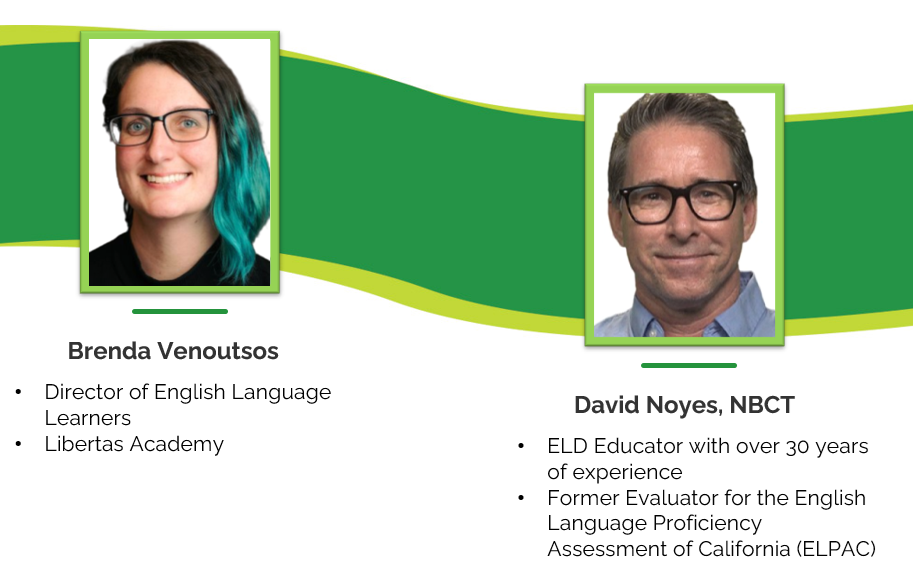
We recently posed this common question to Brenda Venoutsos (Director of ELL, Libertas Academy) and David Noyes, NBCT (Head of Curriculum, Language Tree Online) in a recent webinar. This blog highlights the classroom-tested strategies they shared with the audience.
Q. What strategies should you use when you have a new class of multilingual learners?
Whether students join class at the start of the year or mid-semester, the foundational goal is the same: to lower their affective filter and build the structure and trust that make language output possible. Here's where to start.
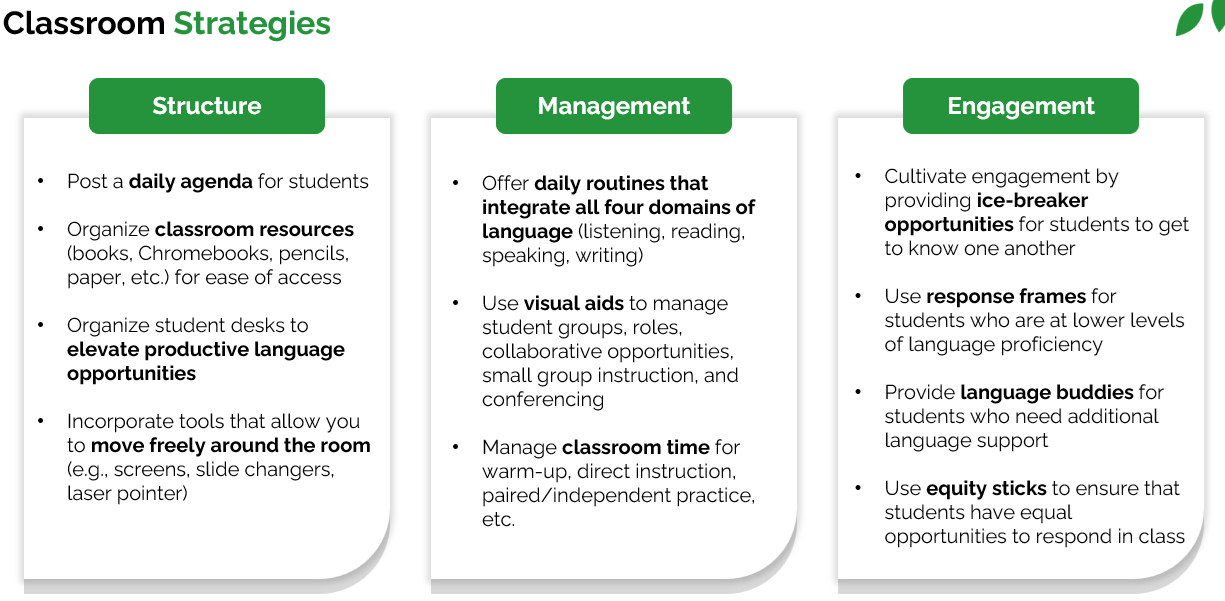
Classroom Strategies for Mixed-Level English learner Classrooms
Post a Daily Agenda
A visible daily agenda is one of the simplest and most effective tools for multilingual learners. When students know exactly what the session will look like and what's expected of them, they can direct their cognitive energy toward language, freeing their attention for learning rather than logistics. It also keeps the teacher anchored to a clear instructional plan.
For example, a daily agenda posted at the start of class might include: warm-up (3 min), vocabulary review (7 min), group practice (10 min), partner practice (10 min), and exit ticket (5 min). Students can see the arc of the lesson from the moment they walk in, which reduces the low-level anxiety of not knowing what comes next and allows them to settle into learning more quickly.
Make Classroom Resources Independently Accessible
From day one, teach students where all materials live, including writing books, Chromebooks, paper, and pencils, so they can access them without disrupting the flow of instruction. The goal is to strengthen student independence. When students can retrieve what they need during direct instruction, pair work, or independent practice, it keeps the classroom running smoothly and builds self-sufficiency.
A simple way to set this up is to designate a consistent spot for each type of material and walk students through the location of every resource on the first day. Reinforce it in the first few weeks by acknowledging when students use it correctly. Say, "Thank you for grabbing your vocabulary notebook without being asked."
Rearrange Desks to Elevate Language Output
The language development classroom thrives on collaboration. Desk clusters facilitate more productive language practice opportunities than traditional rows. Arrange desks in clusters of four and train students to move into those clusters when it's time for peer interaction. It may take about two weeks to establish the routine, but once in place, it will create seamless opportunities for peer-to-peer language practice and give the teacher more room to circulate and support.
One practical approach: number each desk 1 through 4 within every cluster as a simple organizational label. These numbers give the teacher an efficient way to call on specific seats during activities or invite a group to the small group table without any disruption. The strategic element is in how students are seated: place students so that each cluster contains a deliberate mix of proficiency levels. That way, at any point during a turn-and-talk or group activity, every student has a peer at a stronger proficiency level nearby as a natural language model. The desk numbers themselves stay neutral, so no student is publicly identified by proficiency.
Use Technology to Stay Mobile
Staying anchored to the front of the room or behind a desk creates distance, both physical and relational, between teachers and students. When teachers circulate throughout instruction, they lower students' affective filter because proximity signals availability and care. Students who might hesitate to raise a hand across the room will ask a quiet question when a teacher is standing nearby.
Tools that support teacher mobility make this easier to sustain. A wireless slide remote allows teachers to advance slides from anywhere in the room, so instruction never has to pause at the board. A laser pointer lets the teacher draw student attention to specific text or images from a distance. Together, these tools allow the teacher to be in motion throughout the lesson without losing instructional momentum, which is especially valuable in a mixed-level classroom where different students need different levels of proximity-based support.
Integrate All Four Language Domains Every Day
A strong ELD classroom builds all four language skills in every lesson. Create daily routines that weave together listening, speaking, reading, and writing.
For example, have students describe a picture and generate vocabulary (speaking), read the words to a song or poem and unpack meaning (reading/listening), then apply what they've learned in a short, written response (writing). Even brief writing opportunities, like an exit ticket requiring the use of three new vocabulary words in a sentence, count as meaningful language production.
Use Low-Risk Icebreakers to Build Classroom Community
At the beginning of the year, multilingual learners are navigating not just a new class but potentially a new school, a new language, and a new cultural environment. Icebreakers give students an early, successful experience using English in a social setting, which is foundational before any academic language work can take hold.
Keeping icebreakers low-stakes means there is no grade, no wrong answers, and no pressure to perform. Topics students genuinely care about, such as favorite foods, music, sports, and performers, give every student something to say and create a welcoming space for early language production. This is also a great time to introduce differentiated response frames. For students who are building their proficiency, a simple frame like "My favorite food is ___." For students with stronger proficiency: "My favorite food is ___ because ___."
Create Language Buddies Across Proficiency Levels
Within heterogeneous groups, intentionally pair students with stronger proficiency alongside those who are still developing fluency. Peer language models are often more powerful than teacher modeling alone. Students build English structures faster when they hear the language used naturally by a classmate, especially newcomers navigating both language and culture simultaneously.
Use Equity Sticks for Equitable Participation
Writing each student's name on a tongue depressor and keeping them in a cup to use when calling on students ensures every student has both the opportunity and the expectation to participate. It's helpful to note each student's proficiency level on their stick (1 through 4) so you can differentiate your questioning in real time. Students who are building their proficiency receive more scaffolding, while students with stronger proficiency are supported toward longer, more complex responses.
Q. How do you structure a class period when differentiating for multiple proficiency levels?
Reflecting back on the previous section, when students know the structure of their class period, they can focus their energy on language acquisition. A predictable lesson framework removes an invisible barrier for English learners. This allows teachers to differentiate within each phase rather than rebuilding the entire structure every day.
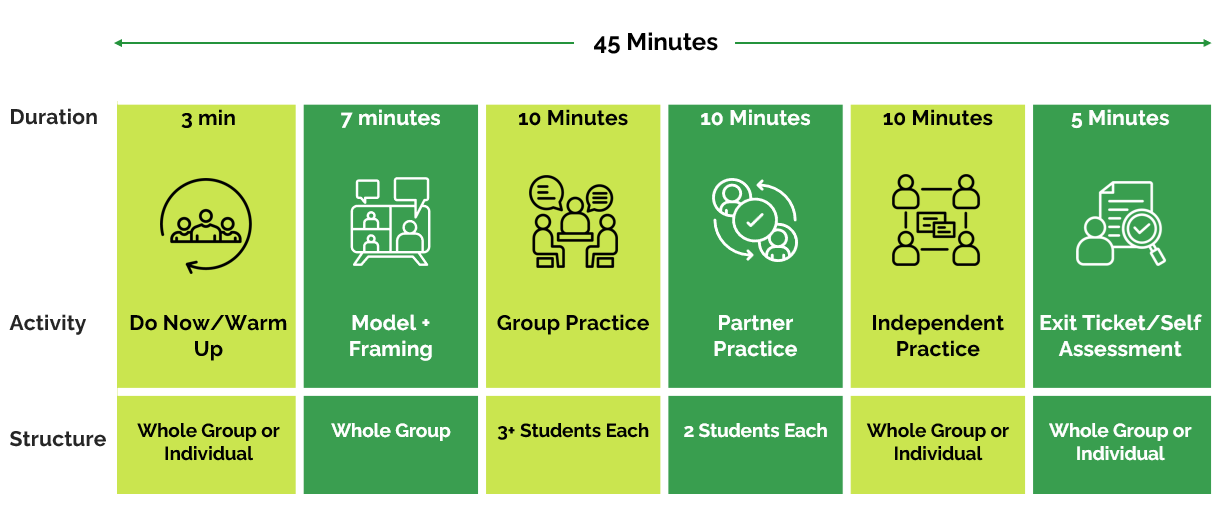
Sample Class Agenda: 45-Minute Block
Here's a framework designed for a 45-minute ELD class period that can be scaled up for block schedules:
1. Do Now / Warm-Up (~3 minutes)
Start with something accessible and based on a previously taught skill. Use the previous day's exit ticket data to decide what goes here: revisit a skill students are continuing to develop, or spiral in a review from weeks prior to maintain mastery over time. The warm-up should always connect to and support the language objective of the day. It serves as an on-ramp into the lesson, building readiness for what comes next.
2. Teacher-Led Model and Framing (~7 minutes)
Keep this short and focused. The goal is to show students exactly what the target skill looks like and give them a clear Criteria for Success (CFS) to work from throughout the rest of the lesson. The CFS should have no more than five components and be simple enough for students to use as a self-monitoring checklist. Keeping teacher talk brief here maximizes the time students spend actively grappling with the material themselves.
A CFS breaks the language objective into concrete, observable steps. For example, if the language objective is "Explain a process using transition words to demonstrate sequence," the CFS might include: (1) Identify all steps or events in the process. (2) Determine the correct order of those steps. (3) Begin the first sentence with the transition word "First." (4) Use "Next" or "Then" for each middle step. (5) Begin the final sentence with "Finally." Students can check their own work against each step as they move through group practice, partner practice, and independent work, which reduces the need to ask for help and builds confidence in self-monitoring.
3. Group Practice (~10 minutes, 3 or more students)
Students practice the target skill in small groups, using the CFS as a checklist. Encourage students to use each other as a resource before coming to the teacher, building peer language practice and developing independence. The teacher circulates, provides feedback, and notes which students are thriving and who would benefit from additional support.
Assigning scaffolded group participation roles can help every student contribute meaningfully, regardless of proficiency level. For example: a Facilitator keeps the group on task and ensures everyone has a turn to speak; a Recorder writes down the group's ideas or responses; a Reporter shares the group's work with the class; and a Timekeeper monitors pacing. These roles should be differentiated so that students starting to build their proficiency can take on roles that rely more on visual or organizational tasks, such as Recorder or Timekeeper, while students with greater language competency take on language-production roles such as Reporter or Facilitator. Over time, rotating roles gives every student practice across all functions.
4. Partner Practice (~10 minutes, pairs)
Two students work together, giving and receiving feedback using the CFS and using the provided sentence frames. This is an additional opportunity to use the language objective before moving into independent work. Think of it as a final practice "at-bat" before assessment, where students can consolidate their learning with a peer.
5. Independent Practice (~10 minutes)
This is the teacher's last opportunity to provide feedback before the exit ticket. Prioritize students who haven't yet received direct feedback during group or partner practice, and circle back to those who would benefit from additional reinforcement. The goal is to make sure every student can tackle the exit ticket task feeling prepared.
6. Exit Ticket / Self-Assessment (~5 minutes)
Completely independent, with no teacher support during this phase. This is your true data point for whether students met the language objective. Results drive the next day's do-now, future grouping decisions, and lesson adjustments. An exit ticket completed independently tells you far more about a student's skill level and informs more targeted instruction going forward.
**Note for block schedules: In a 90-minute period, set a specific goal for the first 45 minutes and a second goal for the second 45 minutes. Either duplicate the lesson framework across both halves, or for larger projects like extended writing, scale each phase proportionally.
Q. How do you keep students engaged, productive, and on-task while working with a small group?
Engagement in a mixed-level classroom is something teachers build deliberately through classroom culture, relevant content, varied learning modalities, and transparent use of data. Here's what research and classroom experience point to as the most effective strategies.
Teacher Energy Sets the Classroom Tone
The energy a teacher brings into the room sets the tone for everyone in it. Teachers who model genuine enthusiasm for the content and hold students to high expectations with warmth and belief tend to see that energy reflected back over time. This applies at the small group level too: bring the same engagement to a pull-out group that you'd bring to whole-class instruction. When a student is off task, addressing it in the moment signals that you care about their learning and believe in their ability to engage.
Use Interest Surveys to Drive High-Relevance Independent Work
At the start of the year, give students an interest survey and then actively use it throughout the year. When the topics students are working on independently reflect their real interests, engagement increases significantly. Relevant independent practice materials keep students focused and productive while the teacher works with a small group.
Incorporate Culturally Relevant Moments in Real Time
When something significant happens in students' cultural world, build it into the lesson. The language skill remains the target; the cultural hook is the vehicle that gets students there with energy and investment.
For example, when Bad Bunny performed at the Super Bowl halftime show, teachers built lessons around his background and the symbolism in his performance. For students from Puerto Rico, the connection was immediate and powerful, and teachers still reached their language objectives. Reaching students where they are culturally makes a meaningful difference in engagement.
Calibrate Independent Work to the Zone of Proximal Development
Students thrive when independent work is calibrated to exactly the right level of challenge. Use exit ticket data and notes from small group and partner practice to ensure the materials students work on independently are well within their Zone of Proximal Development, challenging and achievable with a little push. Reserve higher-demand tasks for small group time, where the teacher is present to scaffold.
Teach to the Brain: Engage Multiple Neural Pathways
Auditory input is one important pathway for language learning, and pairing it with additional modalities deepens retention significantly. Intentionally layer in:
- Visual: Images, diagrams, and visual context help students access meaning and build understanding across all proficiency levels.
- Communicative/Collaborative: When students apply language in a group or partner setting, they engage the communicative pathway, making meaning through social interaction rather than reception alone.
- Kinesthetic: Movement can be as simple as having students stand up during partner or independent practice. Research shows that standing increases oxygen to the brain by 18 to 25 percent, supporting focus and retention. Text reconstruction strips, picture sorting, and classifying activities are also straightforward, high-value kinesthetic tools.
Make Learning Goals Clear, Simple, and Purposeful
Students who know what they're learning and why are far more engaged than students who are simply completing tasks. Keep daily learning goals simple and explicit: what is the skill, and why does it matter in their lives? Every student should leave class able to answer both questions. A clear learning goal also ensures the teacher knows exactly what success looks like that day, which sharpens instruction for everyone.
Use Data to Celebrate Growth
When students see their own language development data regularly, it builds intrinsic motivation. Highlighting growth, not just achievement, helps students become genuinely invested in their own progress. Students who are consistently shown how far they've come and what is within reach begin to self-assess and self-advocate naturally. That level of ownership over language development is one of the most meaningful outcomes an ELD teacher can cultivate.
The Bottom Line
Managing a mixed-level ELD classroom is one of the most complex and most rewarding instructional challenges in secondary education. The strategies above give every English learner, at every proficiency level, a genuine opportunity to produce language, receive feedback, and grow.
Structure creates safety. Consistency creates access. When students feel seen, supported, and challenged at exactly the right level, language development follows.
Interested in learning more about effective management of multilevel English learner classrooms? Watch the full webinar recording.
About Language Tree Online
Want to learn more strategies for supporting English learners? Explore the Language Tree Online resources for standards-aligned ELD curriculum and professional development designed specifically for secondary multilingual learners.